Across healthcare estates, the operational pressures placed upon technical teams have never been more acute. Managing extensive backlog maintenance, integrating low-carbon technologies to meet Net Zero targets, and preparing for rigorous Care Quality Commission (CQC) or external compliance audits leave very little breathing room for Estates and Facilities managers.
Underneath these highly visible daily operational challenges lies a foundational issue that directly determines the safety, efficiency, and continuity of the entire hospital environment: the workforce competency gap.
With a significant proportion of senior Authorised Persons (APs) and estate engineers approaching retirement, trusts are at risk of losing decades of vital institutional memory. Simultaneously, the technical demands placed on modern healthcare estates are expanding rapidly. Today's hospital infrastructure requires strict, unwavering adherence to evolving Health Technical Memoranda (HTMs), alongside an understanding of increasingly complex digital and automated building management systems.
Certification to Competence
In this current climate, relying on a traditional compliance model is no longer enough. While formal certifications and qualifications provide estates and facilities teams with essential baseline knowledge, they represent only the starting point of professional capability. Holding a certificate of attendance from a five-day training course does not, by itself, make an engineer safe to issue a permit-to-work in a live intensive care unit. As Authorising Engineers (AEs) frequently observe during annual audits, true compliance is not about paper credentials, it is about demonstrated, site-specific competence.
The transition from baseline certification to true competence requires actively embedding classroom theory into daily practice. It means learning to navigate ageing infrastructure safely, understanding the nuances of strict compliance mandates, and adapting to rapid technological shifts at the patient bedside.
Moving beyond a basic compliance mindset demands deliberate post-qualification pathways. Trusts must implement structured programmes, regular audits, and continuous on-site assessments. By fostering a workplace culture that actively bridges the gap between what is proven on a written exam and what is safely delivered under operational pressure, NHS trusts can build an agile, resilient workforce capable of maintaining patient safety and clinical excellence.
IHEEM 2026: The Importance of Presence
Addressing this competency gap requires much more than digital communication or theoretical discourse; it requires active, face to face collaboration. We exhibit at IHEEM every year because it provides an unparalleled platform to move beyond surface-level conversations and demonstrate practical, hands-on solutions directly to the people managing the NHS estate.
The exhibition floor allows us to listen to specific, site-level challenges faced by Facilities Managers and APs across the country. It is a space where the industry can openly discuss how to genuinely integrate modern, sustainable technologies without compromising critical HTM compliance or disrupting patient care. These in person interactions are vital for identifying exactly where the knowledge gaps lie and developing targeted training and support in the aim to close them.
New Course Alert: HTM 02-01 Update Course
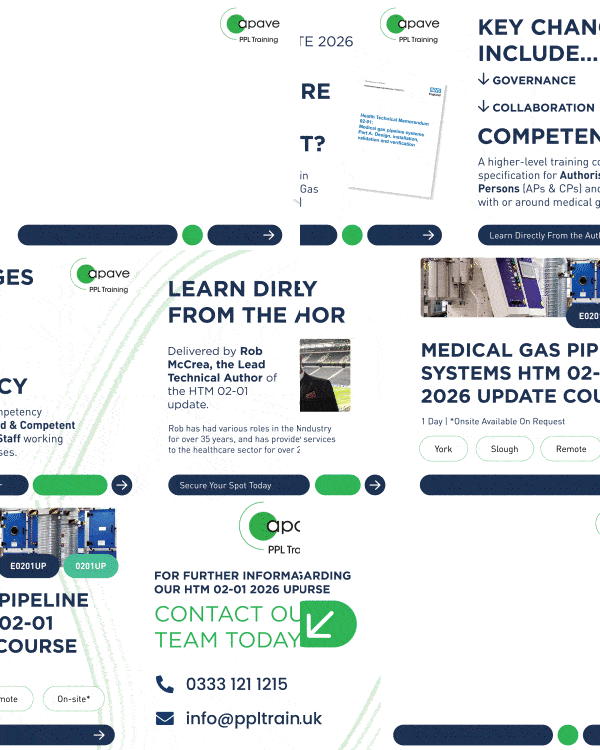
To directly support this drive for elevated competence, we have officially launched our Medical Gas Pipeline Systems (MGPS) HTM 02-01 Update Course. This launch was marked by an inaugural session at our York Centre, delivered directly by Rob McCrea, the lead technical author of the new update.
Representing the most significant overhaul to MGPS guidance in nearly twenty years, HTM 02-01 (2026) reinforces foundational patient safety while placing substantial new emphasis on governance, lifecycle asset management, operational assurance, and overall system resilience.
Through practical case studies, structured comparisons of the legacy 2006 and updated 2026 editions, and technical guidance from the author himself, the course offers unparalleled insight. It equips designers, installers, APs, Competent Persons (CPs), and healthcare management teams with actionable clarity on revised operational procedures, shifting legal responsibilities, and NHS England’s latest documentation expectations.
Empowering the Future of Healthcare Infrastructure
The resilience of the NHS estate is ultimately defined by the people who manage, maintain, and operate it. Upgrading physical infrastructure and adopting sustainable technologies will only succeed if the workforce is equipped with the deep, practical expertise required to oversee these systems safely.
By prioritising site-specific competence over basic certification, investing in robust training pathways, and fostering collaborative partnerships across the sector, Estates and Facilities teams can confidently meet the challenges of modern healthcare. Ensuring our technical teams are fully supported and comprehensively trained is not just a regulatory requirement; it is a fundamental commitment to the safety and continuity of patient care.