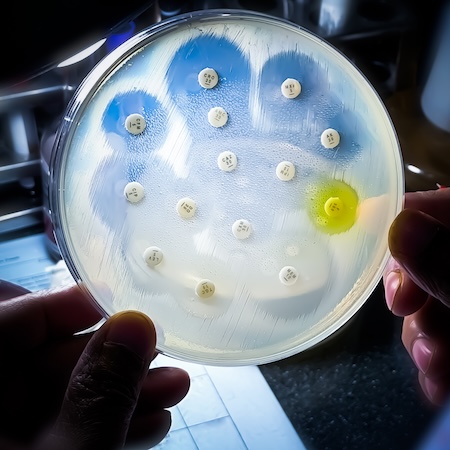
Following a decline during the COVID-19 pandemic, the number of antibiotic-resistant bacteraemia (the presence of bacteria in the bloodstream that are resistant to one or more antibiotics) caused by bacterial species of public health importance has increased year-on-year over the six-year period from 2019 to 2025.
The English Surveillance Programme for Antimicrobial Utilisation and Resistance (ESPAUR) collects data on the use of, and resistance to, antimicrobial medicines (antimicrobial resistance or AMR), including antibiotics, antivirals, antifungals and antiparasitics. It reports that between 2019 and 2025, the number of antibiotic-resistant bacteraemia increased by 16.8%, from 18,086 in 2019 to 21,129 in 2025. In 2025, this was equivalent to an average of 406 patient episodes each week in 2025.
The most common bacteria were Escherichia coli (E. coli), Klebsiella pneumoniae and Klebsiella oxytoca, which together accounted for 85.5% of all patient episodes in 2025. E. coli was responsible for the largest proportion, accounting for 70% of all patient episodes of antibiotic-resistant bacteraemia recorded over the past seven years.
The number of bacteraemia and antibiotic-resistant bacteraemia decreased during the COVID-19 pandemic, probably due to reduced person-to-person contact, better hygiene and a change in how people used healthcare services. Some infections may also have been missed or diagnosed less often during this period. An increase in bacteraemia following the end of pandemic restrictions was expected as people resumed normal social contact. However, the increase in the last four years has been substantial. There are now more episodes of antibiotic-resistant bacteraemia in England than at any other time on record.
The cost of AMR
Around 53,400 hospital admissions were linked to serious Gram-negative bloodstream infections in 2023-2024, costing the NHS an estimated £800m. The financial impact is clearly significant, although these figures do reflect the total cost of hospital stays, not the portion directly caused by the drug-resistant infection. Further work is underway to estimate the costs specifically attributable to AMR and to assess its wider impact on patients and the healthcare system.
New & notable threats
Trichophyton indotineae infection is an emerging fungal skin infection, often resistant to standard treatments, that is spreading in the UK, with cases increasing rapidly since 2023.
Rates of MSSA (methicillin-susceptible S. aureus) bloodstream infections have continued to rise over time, while MRSA (methicillin-resistant S. aureus) bloodstream infections, which had previously remained low and stable, have also increased in recent years.
AMR and the built environment
Whilst much of the work being undertaken to tackle AMR is directed at the unnecessary and inappropriate prescribing of antibiotics, bacteria thrives in the built environment and Estates & Facilities teams also need to understand the threat and adopt strategies to mitigate it.
Speaking at the recent Healthcare Estates event, Karren Staniforth, Consultant Clinical Scientist, UKHSA, Healthcare Infection Society, described current microbial evolution as “stratospheric.” As well as ensuring the highest standards and correct frequencies of cleaning, speakers in this session addressed the need to understand how pathogens are changing and their transmission, to share guidance, knowledge and best practice across organisations as well as staff groups.
The November/December issue of HEFMA Pulse magazine has more detail on this presentation from Healthcare Estates, as well as an in-depth report from the Chartered Institute of Building (CIOB) focusing on why collaboration between those responsible for designing and operating the built environment and those responsible for infection prevention and control is absolutely essential to tackle the growth of superbugs.